

- None of AOD-9604's obesity trials were ever published in the peer-reviewed literature. Every fat-loss number you see quoted for it traces back to the sponsor's own announcements, not to a paper anyone can check.
- Metabolic Pharmaceuticals ran the compound through human testing and walked away from the obesity programme in 2007 after the larger, longer trial came back negative.
- The fat-releasing effect appears to be real early and then to fade. Something showed up at 12 weeks and nothing did at 24, which is the pattern of a receptor that stops answering.
- WADA bans AOD-9604 under S2 (four-year non-specified sanction). The FDA voted against allowing it to be legally compounded in December 2024.
- The release valve on your fat cells is a receptor built by the ADRB3 gene, and some people build a version that answers less readily. That is the exact pathway AOD-9604 leans on, and no trial ever sorted its results by genotype.
AOD-9604 went further into human testing than most peptides you will find at a compounding clinic today. A real pharmaceutical company, serious funding, a programme that ran to a properly powered trial. And it failed to beat placebo when the stakes were highest. That sequence tells you something specific about how this peptide works, and it is the most important thing to understand before you add it to a fat-loss protocol.
Before any number in this article: none of the AOD-9604 obesity trials were ever published in the peer-reviewed literature. Search PubMed and you will not find them. The participant counts and kilogram figures that circulate online all trace back to the sponsor company's own announcements. That does not make them false, but it does mean no independent reader has ever been able to check the analysis, and you should hold every one of them loosely.
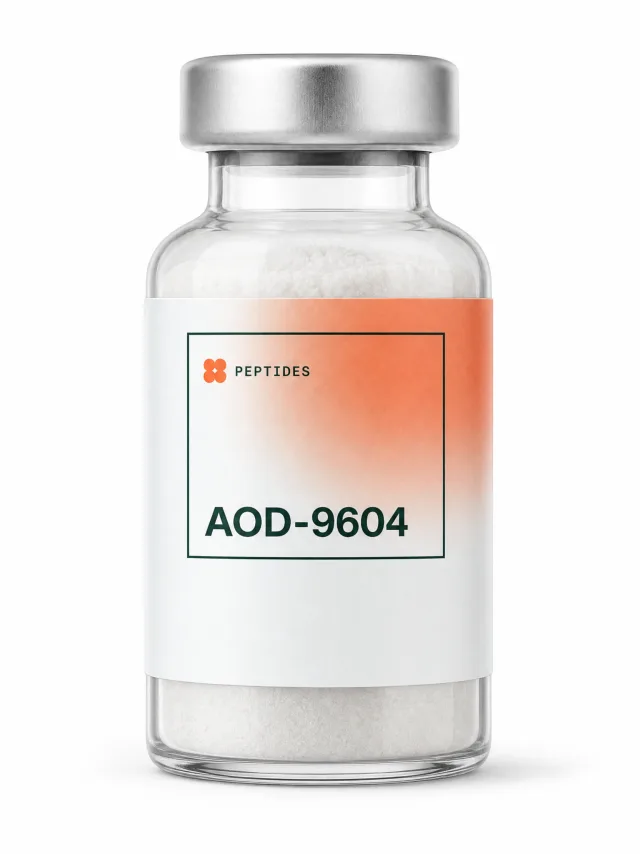
AOD-9604 is a synthetic fragment of human growth hormone: the last 16 amino acids of the chain (positions 176 to 191) with a tyrosine tacked on the front. Developed by Metabolic Pharmaceuticals, a Monash University spin-out in Melbourne, it had one design goal: capture the fat-releasing effect of growth hormone without the insulin resistance that full-length GH produces at fat-loss doses.
The mechanism is well established in animal models. AOD-9604 activates beta-3 adrenergic receptors on fat cells, triggering the breakdown of stored fat into free fatty acids. It does not raise IGF-1. It does not suppress insulin. In obese Zucker rats, 500 micrograms per kilogram per day for 19 days cut weight gain by more than 50 percent compared to untreated controls without impairing glucose metabolism, according to Ng et al. in Hormone Research (2000). That is exactly the profile you want in an obesity drug. And then came the human data.
Think of beta-3 adrenergic receptors as the release valve on fat cells. When they fire, stored fat flows out as free fatty acids. AOD-9604 is designed to hit only that valve, without the broader side effects that come from activating the full growth hormone receptor. The problem is not whether it opens the valve. The problem is that the valve seems to stop responding after a few weeks of continuous activation.
What did the Phase IIa trial show, and why did it raise hopes?
The Phase IIa trial tested several oral dose levels against placebo over 12 weeks. The result that generated press coverage came from the lowest active dose, 1 mg per day, which was reported to separate from placebo on fat loss. The specific kilogram figures quoted everywhere online come from company announcements rather than a published trial report, so treat the size of that separation as unverified.
Two features of the Phase IIa account were already concerning at the time. First, the dose-response ran backwards: the higher dose groups performed worse than the 1 mg group. A compound where more is less is unusual for a drug candidate and makes it very hard to optimise. Second, even on the sponsor's own telling, the benefit over placebo was modest. Metabolic Pharmaceuticals pressed on to the pivotal trial anyway.
Why did the pivotal 24-week trial fail despite the earlier signal?
The Phase IIb "OPTIONS" trial enrolled 536 subjects across multiple countries, testing doses of 0.25, 0.5, and 1 mg per day orally for 24 weeks. Double-blind, randomized, multicenter, powered to detect a clinically meaningful weight difference. The result was unambiguous: no statistically significant difference in weight loss versus placebo at any dose tested.
"The Phase 2B trial results for AOD9604 do not support the commercial viability of the drug as a treatment for obesity. The compound appeared safe and well-tolerated, but the efficacy signal from the earlier trial did not replicate at scale."
Valentino, Lin, and Waldman, Clinical Pharmacology and Therapeutics, 2010
Metabolic Pharmaceuticals discontinued the obesity program in 2007. Across all six trials, no serious adverse events were recorded. The compound was safe. It simply did not produce sustained, clinically meaningful fat loss in a properly powered human study. The company later pivoted to licensing AOD-9604 as a cosmetic ingredient (Phosphagenics acquired it for an anti-cellulite cream, BodyShaper) and explored an oral formulation for osteoarthritis, both of which also stalled without regulatory approval. Human therapeutic development ceased entirely.
Why do the first few weeks seem to work if the long-duration trial failed?
This is the question most coverage of AOD-9604 does not answer, and it matters practically for anyone considering it today. The Phase IIa trial ran 12 weeks and found a signal. The Phase IIb trial ran 24 weeks and found nothing. The signal that appeared at 12 weeks had disappeared by 24 weeks. That pattern points to a fat-releasing effect that is real but self-limiting over time.
Beta-3 adrenergic receptor downregulation is a well-documented phenomenon. Chronic stimulation of beta adrenergic receptors reduces receptor density and coupling efficiency over time. If AOD-9604 produces a burst of fat release in the first 4 to 8 weeks that gradually attenuates as receptors desensitize, a 12-week trial would capture the burst while a 24-week trial would capture the return to baseline. This has not been directly tested in the AOD-9604 program, but it is mechanistically consistent with what the trial data shows.
The practical implication for anyone who uses it: short cycles with breaks may produce better results than continuous dosing. Continuous daily administration for 24 weeks is probably not the optimal protocol, even though that is exactly what the pivotal trial tested. For how receptor desensitization shapes cycling decisions across peptide classes, the peptide cycling protocol guide covers this mechanism in detail.
How does AOD-9604 compare to semaglutide for fat loss?
Some wellness clinics market AOD-9604 as a "non-GLP-1 fat-loss alternative" following compounded semaglutide restrictions in 2025 and 2026. This framing is misleading, and the evidence gap between these two approaches is very large.
AOD-9604
Mechanism: opens the release valve on fat cells, with no effect on appetite. Phase IIb result: failed to beat placebo at 24 weeks. No Phase III data. Not FDA-approved. Not legally compoundable in the U.S. as of December 2024. WADA-banned under section S2 (four-year sanction). Best reported human result: a modest separation from placebo at 12 weeks, from a trial that was never published.
Semaglutide (Wegovy)
Mechanism: GLP-1 receptor agonist, reduces appetite and slows gastric emptying. Phase III STEP 1 result: 14.9% body weight loss over 68 weeks versus 2.4% for placebo. FDA-approved for obesity since 2021. Multiple completed Phase III trials covering tens of thousands of subjects. Average fat loss roughly 15 kg in clinical trials.
The comparison is not close on efficacy. If your goal is meaningful sustained fat loss, the clinical evidence overwhelmingly favors GLP-1 drugs. AOD-9604 occupies a different niche: potentially useful in short cycles for people who cannot or will not use GLP-1 drugs, but without the regulatory standing, mechanism of action, or efficacy profile to function as a replacement. For a detailed look at which genetics predict GLP-1 non-response, the semaglutide non-responder genetics guide covers the relevant variants.
| Evidence metric | AOD-9604 | Semaglutide |
|---|---|---|
| Pivotal trial result | Failed Phase IIb (no significant loss at 24 weeks) | 14.9% body weight loss in STEP 1 (68 weeks) |
| Phase III trials completed | None (program ended at Phase IIb) | Multiple (SUSTAIN, STEP series) |
| Total human subjects | Reported by the sponsor, never published | Tens of thousands across all trials |
| FDA status | Unapproved, not legally compoundable (Dec 2024 PCAC vote against) | Approved for obesity (2021) and type 2 diabetes (2017) |
| WADA status | Banned under section S2 (four-year sanction, no medical exemption available) | Not on prohibited list |
| Mechanism | Opens the release valve on fat cells (no appetite effect) | GLP-1 receptor: appetite, gastric emptying, insulin secretion |
Why a flat average can hide two very different groups of people
Here is what none of the trials ever answered: who were the responders, and did anything inherited separate them from the non-responders? The results were reported as averages across everyone enrolled. If one subgroup lost meaningful fat while another lost nothing, the average would look flat either way. That may be part of what happened in the pivotal trial.
AOD-9604 works by opening the beta-3 receptor, the release valve on a fat cell. The gene that builds that receptor is ADRB3, and one common version of it, rs4994 or Trp64Arg, passes the signal on less efficiently once the valve is triggered. A 2020 meta-analysis in Adipocyte covering 16 studies and 12,497 subjects found that Trp64Arg carriers have 23 to 39 percent higher odds of overweight and obesity, with the strongest signal in East Asian populations. If your ADRB3 receptor does not couple efficiently, AOD-9604 is activating a pathway that is already impaired in your biology. The early trial data also suggests a non-linear response: the 1 mg/day dose outperformed all higher doses. Receptor-level impairment may explain both the non-linearity and the between-subject variability.
There is a second layer. LEPR builds the docking point for leptin, the hormone that tells your brain you have eaten enough, and the versions that dull that signal are common in people who struggle most with fat loss. AOD-9604 does not work through the leptin pathway at all, so LEPR-driven weight resistance is not addressed and not overcome by the peptide. For a broader framework on how beta-adrenergic, leptin, and GLP-1 pathways interact in fat-loss response, the peptides for weight loss guide covers the multi-pathway picture. For the full decision tree across peptide categories, the DNA-first peptide selection framework maps out how to use those results.
Is AOD-9604 legal to use in the United States right now?
In the United States, AOD-9604 cannot currently be legally compounded. The FDA's Pharmacy Compounding Advisory Committee voted against including it on the 503A Bulk Drug Substances List at its December 4, 2024 meeting, citing an inadequate chemical description of the substance and insufficient evidence that it works. The compound was removed from Category 2 of the interim 503A bulks list on September 27, 2024 (the nominator withdrew), reverting to default prohibition status. There is no 503B outsourcing facility pathway either. Products sold online operate entirely outside FDA oversight.
One regulatory fact that is consistently misrepresented: AOD-9604 holds an FDA GRAS notice (GRN 000546, 2014), meaning it is Generally Recognized As Safe for use as a food ingredient. Some vendors cite this as regulatory approval or a safety endorsement. It is neither. GRAS is a food designation with a separate and much lower evidence bar than drug approval. It does not legalize injectable, therapeutic, or human drug use.
In Australia, where the compound was developed, AOD-9604 is Schedule 4 (prescription-only) under the TGA Poisons Standard, effective June 2015, partly driven by ASADA scrutiny following the 2012 to 2013 Essendon AFL supplements scandal. With no listing on the Australian Register of Therapeutic Goods (ARTG), no prescribing or dispensing pathway exists for any practitioner. The drug was never approved. Older articles that cite TGA "listed complementary medicine" status as a form of approval are wrong: TGA-listed products are not evaluated for efficacy before listing.
For competitive athletes anywhere in the world: WADA classifies AOD-9604 under S2 (Peptide Hormones, Growth Factors, Related Substances and Mimetics) as a growth hormone fragment, non-specified status. The prohibition has been in place since at least 2011 and is carried through the 2026 Prohibited List. A positive test carries a four-year ban with no therapeutic use exemption available for any indication.
Who is actually a reasonable candidate for AOD-9604 today?
Given the full evidence profile, there is a narrow honest case for AOD-9604 in specific circumstances. You need: realistic expectations of modest early fat mobilization (not sustained weight loss); willingness to operate in the legal grey zone outside the U.S.; ADRB3 genetics that do not already impair the target pathway; and a goal that does not require the kind of body weight reduction that only GLP-1 drugs have demonstrated at scale.
The strongest theoretical case is for short cycles of 4 to 8 weeks in people with intact ADRB3 signaling who are adding AOD-9604 as an adjunct to an existing fat-loss protocol, not as a primary intervention. The weakest case is for anyone expecting sustained results comparable to the Phase IIa outcome, anyone carrying ADRB3 Trp64Arg, anyone competing in a tested sport, or anyone in the United States trying to source it through a licensed compounding pharmacy.
If sustained fat loss is the primary goal, the weight of evidence points to GLP-1 drugs for people who can access and tolerate them. If those are not an option and you want to understand how AOD-9604 fits relative to other peptide-based fat-loss options, the AOD-9604 peptide profile covers mechanism comparisons in detail. The honest read from the six-trial record is that AOD-9604 produced a real but modest signal at 12 weeks that vanished by 24 weeks. That is the entire evidentiary foundation for everything being sold today.
Verdict: AOD-9604 went through more human testing than almost any research peptide in the fat-loss category and still reached approval nowhere. The record points to a real but short-lived burst of fat release that fades before it clears a regulatory or clinical bar, and none of it was ever published for anyone to check.
If you have run a full genetic panel and confirmed intact ADRB3 signaling, a short 4-to-8-week cycle as an adjunct to a broader protocol may produce measurable early fat mobilization. But the pivotal trial failure is not a technicality. It is the evidence. Upload your existing DNA data to see your full fat-loss gene profile including ADRB3 and LEPR variants, or order a saliva kit to find out whether your receptor genetics put you in the responsive subgroup that none of the six trials ever identified.
Frequently asked questions
What is AOD-9604 and how does it work for fat loss?
AOD-9604 is a 16-amino-acid synthetic fragment of human growth hormone (positions 176 to 191, plus a tyrosine on the front). It opens the beta-3 receptors on fat cells, which triggers the breakdown of stored fat into free fatty acids the body can burn. Unlike full-length growth hormone, it does not raise IGF-1 or impair insulin sensitivity. Animal studies showed strong fat-mobilizing effects; the human data is more complicated.
What results should I realistically expect from AOD-9604?
Modest and early, if anything. The 12-week trial reported a separation from placebo at the 1 mg daily oral dose, but that trial was never published, so the size of it cannot be checked. The larger 24-week trial showed no significant fat loss at all. User reports describe noticeable early changes in the first 4 to 6 weeks that plateau or reverse with continued dosing. Calibrate to that shape rather than to the animal data or to any single quoted kilogram figure.
What is the standard AOD-9604 dosing protocol?
The Phase IIa trial found 1 mg per day oral to be more effective than higher doses (5, 10, 20, or 30 mg per day). Current compounding and research-chemical use typically delivers 250 to 500 micrograms subcutaneously each morning in a fasted state, which is the injectable equivalent of the oral 1 mg dose. No published human trial has validated subcutaneous delivery specifically. Given the plateau evidence, most practitioners favor 4-to-8-week cycles with breaks rather than continuous daily dosing.
Is AOD-9604 legal to use or buy in the United States in 2026?
No, not through licensed compounding pharmacies. The FDA's Pharmacy Compounding Advisory Committee voted against including AOD-9604 on the 503A Bulk Drug Substances List in December 2024. It cannot legally be compounded by 503A pharmacies or 503B outsourcing facilities. Products sold online through research chemical vendors operate outside FDA oversight. The GRAS notice (GRN 000546, 2014) that some vendors cite covers only oral food-ingredient use and does not legalize therapeutic or injectable use.
Can AOD-9604 be stacked with CJC-1295 and ipamorelin?
Stacking AOD-9604 with growth-hormone-releasing peptides like CJC-1295 and ipamorelin is common in the peptide community. The rationale is that AOD-9604 opens the release valve on fat cells directly while the other two increase the size of your natural growth hormone pulses. No clinical trial has tested this combination or demonstrated additive fat loss in humans. The mechanisms do not directly compete, so the combination is not obviously harmful, but any expected synergy is theoretical.
Why did AOD-9604 fail the Phase IIb trial if Phase IIa showed results?
The most plausible explanation is that the receptor stops answering. The 12-week trial captured an early burst of fat release. The Phase IIb trial ran 24 weeks and found that same response had disappeared. Beta adrenergic receptors are well known to downregulate under chronic stimulation, which would explain why an effect visible at 12 weeks is absent by 24 weeks. The non-linear dose response in Phase IIa (where higher doses actually performed worse than 1 mg per day) was an early sign that this compound's window of effect was narrow and hard to optimize.
Why might AOD-9604 do nothing for one person and something for another?
Part of the answer may be the receptor itself. AOD-9604 works by opening the release valve on fat cells, and the ADRB3 gene that builds that valve comes in a version (rs4994, or Trp64Arg) that passes the signal on less efficiently. A meta-analysis of 16 studies covering 12,497 people found carriers have 23 to 39 percent higher odds of carrying excess weight. No AOD-9604 trial ever split its results by genotype, so this is a mechanistic argument rather than a tested one. It does tell you whether you are starting from a working valve or a sticky one.
This article is for informational and educational purposes only. It is not medical advice and does not diagnose, treat, cure, or prevent any disease. Consult a qualified healthcare professional before starting any peptide protocol. Individual results vary. Some outbound links are affiliate links, at no extra cost to you.